
Gemmes de France develops advanced technologies related to synthetic gems. The first of these—which actually brings together several innovations—is ultra-high-density digital data storage, intended in particular for data centers.
Preamble
Definitions
To help visualize the large storage capacities mentioned here, for simplicity, we can consider that a current laptop has a capacity of about one terabyte (TB – 10¹², or one trillion characters); a byte representing one character.
One petabyte (PB – 10¹⁵) is equivalent to the storage capacity of about one thousand laptops.
One exabyte (EB – 10¹⁸) equals one million laptops.
One zettabyte (ZB – 10²¹) equals one billion laptops.
And one yottabyte (YB – 10²⁴) equals one trillion laptops.
Big Data
Big Data refers to extremely large datasets, coming from multiple sources (such as the Internet, connected devices, IT systems of public bodies and companies, etc.), which are distributed at high speed. These data, whether structured or not, are analyzed to extract useful information, notably by Artificial Intelligence (AI).
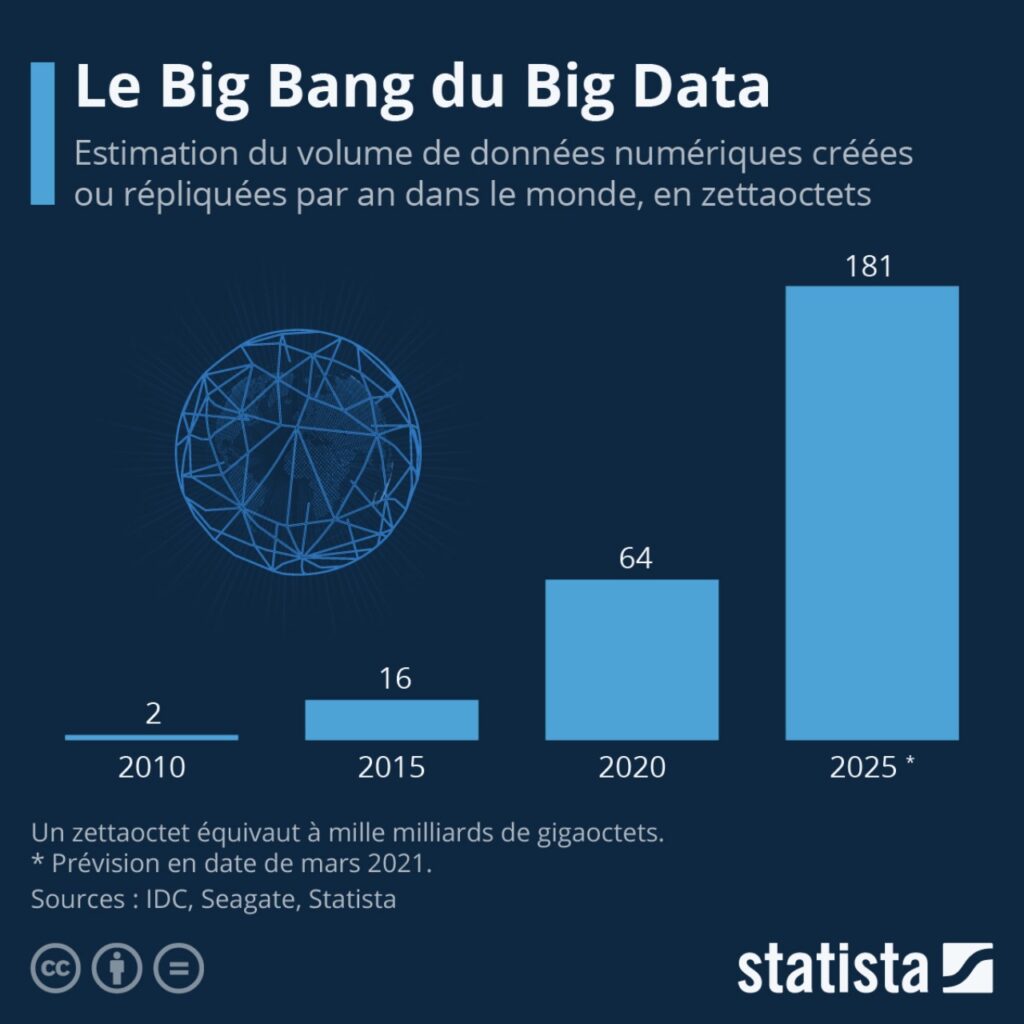
Big Data relies, among other things, on storage units whose volume was about 2 zettabytes in 2010; forecasts for 2025 reach 181 zettabytes, and 2,142 zettabytes—or more than 2 yottabytes—for 2035 (Source in French: https://fr.statista.com/infographie/17800/big-data-evolution-volume-donnees-numeriques-genere-dans-le-monde). This growth in data volume highlights the importance of Big Data in our digital society.
Population growth, the expansion of knowledge, and technological advances—especially in AI and robotics, which generate their own data—necessarily lead to an exponential increase in storage needs.
Big Data Power Consumption
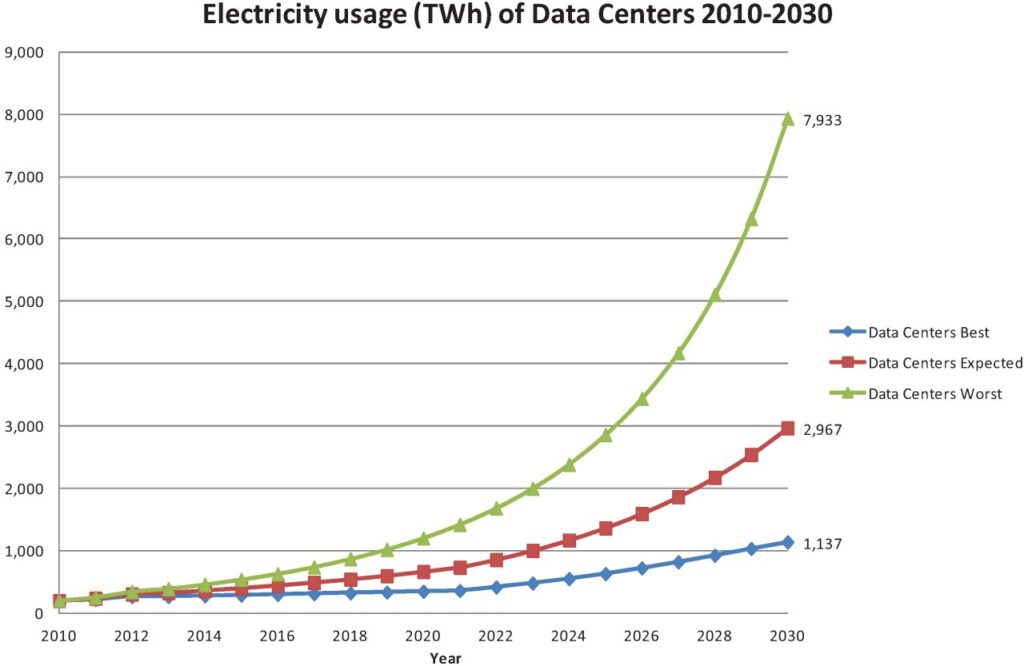
In parallel with the evolution of Big Data volumes, the power consumption of data centers represented about 2% of global consumption in 2013 and could reach 13% by 2030, according to a study by Huawei Technologies.
Artificial Intelligence
Initially, only traditional AI existed: it performed specific tasks by following predefined rules and generally provided a single answer. Then came generative AI, capable of creating new original content (text, image, video, music) by learning from existing data.
An important element to consider is the rapid evolution of generative AI. According to consulting and research firm Gartner, by 2025:
• More than 30% of new drugs and materials will systematically be discovered using generative AI techniques.
• 30% of marketing messages from large companies will be generated by automated machines, compared to less than 2% in 2022.
The evolution of AI has also been exponential in terms of the volume of data processed, the complexity of models, and large-scale deployment:
• In 2010: 2 terabytes of training data for AI models, with millions of parameters and a few thousand AI systems in production.
• In 2020: 64 zettabytes of data for large language models, some AIs—like GPT-3—reaching 175 billion parameters, and millions of AI systems in use.
• Estimates for 2025: 181 zettabytes of data, models with trillions of parameters, and billions of AI systems embedded in various devices.
• Projections for 2035: Potential for yottabytes of data, models with possibly quadrillions of parameters, and AI omnipresent in almost every aspect of technology and daily life.
Sources in French :
– https://fr.statista.com/infographie/17800/big-data-evolution-volume-donnees-numeriques-genere-dans-le-monde/
– https://www.journaldunet.com/big-data/1424245-le-volume-de-donnees-mondial-sera-multiplie-par-45-entre-2020-et-2035-selon-statista/
– https://balises.bpi.fr/les-data-centers-13-de-la-consommation-energetique-mondiale-en-2030/
Gemmes de France Innovation: Addressing the 21st Century Data Storage Challenges
As the preamble shows, the digital era is characterized by an exponential growth in data volumes to be stored. This dynamic, driven by the widespread adoption of cloud computing, the rise of artificial intelligence, robotics, the Internet of Things, and professional and institutional uses, is placing unprecedented pressure on global storage infrastructures.
A Breaking Point: Exploding Needs, Reached Limits
Current storage technologies, used in data centers, (hard drives, SSDs, magnetic tapes, etc.) are reaching their limits:
- The production of storage media is growing more slowly than the volume of data generated: the gap widens every year, threatening the ability of companies and organizations to preserve their strategic, scientific, or regulatory information.
- The environmental impact is becoming severe: the manufacture of current media requires rare earth elements and critical materials, increasing pressure on natural resources and supply chains.
- The explosion in the number of data centers: to keep up with data growth, more and more giant storage centers must be built, consuming huge amounts of electricity and water.
Projections indicate that data centers could account for 13% of global electricity production by 2030. If data multiplication continues at the same pace, it will become impossible to meet energy demand without sacrificing other human activities or foregoing the storage of some knowledge and information.
Why a New Storage Technology is Essential
The development of AI, robotics, digital health, finance, scientific research, and public administration depends on the capacity to store, secure, and exploit growing volumes of data.
The physical and environmental limits of current technologies require a breakthrough: it is necessary to invent radically more compact, durable, energy-efficient, and resource-conscious solutions.
The innovation: A Major Technological Breakthrough Validated Scientifically
Gemmes de France offers a very high-density data storage solution based on inscribing information inside high-purity synthetic gems (CVD diamond) rather than on the surface as some technologies do.
The feasibility of this innovation has been confirmed by a spin-off from the French National Center for Scientific Research (CNRS), thus guaranteeing its scientific and industrial credibility.
Key strengths of this technology:
- Unmatched density: storage of 1 TB per cm³ in the short term, with a potential of 10 to 100 TB/cm³ in the medium term, and much more in the long term. The innovation allows concentrating considerable data volumes in a minimal physical space, drastically reducing the size and number of data centers required.
- Longevity and reliability: benefiting from the physical properties of the medium (diamond), data inscribed in the gem are protected from physical and chemical degradation, are immune to electromagnetic waves, withstand high and low temperatures, and most corrosive agents. The lifespan of the medium is measured in millions of years.
- Security: the first version of the innovation is write-once, ensuring the integrity of archived data.
- Energy and water savings: unlike conventional storage units that require constant power to maintain data availability, gem-based storage consumes energy only during write or read operations. Less physical space also means reduced needs for cooling and water consumption.
- Reduced negative environmental impact: synthetic gem production does not rely on rare earths, and the compactness of storage limits infrastructure multiplication and their sizes. Fewer data centers mean less pressure on natural resources and a lower carbon footprint, especially considering that storage media are not replaced every 10 or 20 years.
Comparison with Synthetic DNA Storage: Density vs. Durability
The only current technology offering greater storage density than the Gemmes de France‘s innovation is Synthetic DNA storage. However, DNA is extremely fragile: it does not withstand electromagnetic waves, extreme temperatures, or most chemicals.
Its long-term preservation requires encapsulation in protective materials, and the issue of slow read/write times remains unresolved.
Conversely, Gemmes de France’s technology, while already offering exceptional density, guarantees unmatched durability and robustness.
Robotics, Embedded AI, and Local Storage: A Critical Challenge
Robotics and embedded AI are booming and pose specific storage challenges:
- Example of autonomous vehicles: such a vehicle generates several terabytes of data daily, necessary for continuous learning and passenger safety. This data cannot be stored remotely (cloud) due to latency, network losses, or the need to react in real time to new critical situations.
Thus, it is essential to have very high storage capacity on board, which is compact, reliable, and durable. - Anthropomorphic, domestic, or industrial robots: these systems will also need to carry large amounts of data to operate autonomously, intelligently, and securely. Because of their weight/volume and energy consumption, current storage units cannot meet these needs, which adds further value to Gemmes de France’s innovation.
First Write-Once Version of the Innovation
As it is legitimate to question the interest of a write-once technology, it is important to recall that 60% of data stored in data centers do not need rewriting but must be preserved long term for legal, heritage, or regulatory reasons.
The first version of Gemmes de France’s innovation therefore meets the majority of data center needs.
For data that are regularly updated, in the decade to come, the second version of the innovation, this time rewritable, will cover all digital storage needs.
Strategic Markets and Use Cases
Gemmes de France primarily targets actors facing critical storage needs:
- Data centers, digital archives, cloud platforms: to support growing data volumes while controlling costs and environmental impact.
- Banks, public sector, healthcare, administration: to ensure the security and sovereignty of sensitive or critical data.
- Companies with strong constraints on space, weight, or energy: robotics, autonomous vehicles, aerospace, space, where compactness, lightness compared to existing storage, and robustness are key.
- Research institutes, laboratories, AI and big data startups, cybersecurity: to support innovation and massive data management.
A Lever for Competitiveness and Ecological Transition
By adopting Gemmes de France’s technology, organizations can:
- Reduce the size and cost of their storage infrastructures.
- Decrease their energy and water consumption and environmental damage.
- Secure and preserve their strategic data over the very long term.
- Enhance their image as responsible and innovative actors.
Perspectives and Call for Partnerships
Gemmes de France has an ambitious and proactive roadmap:
- Continuous increase in storage density.
- Implementation of the rewritable version and data readers adapted to each use case.
- Development of other innovations linked, directly or indirectly, to gems.
- Opening to industrial, institutional, and financial partnerships to accelerate technology development and future solutions.
Companies, institutions, and investors interested in this first innovation are invited to contact Gemmes de France to explore collaboration opportunities.
In summary, Gemmes de France’s innovation offers a concrete and sustainable response to the major data storage challenges of the 21st century. It paves the way for sustainable digital growth without compromising security, sovereignty, or performance.
Reproduction prohibited – Image sources: Google and Statista